Recording Allocation of Off-Site Biodiversity Gains: A Step-by-Step Guide
Are you looking to record allocation of off-site biodiversity gains to your development project? We’ve got you covered with a clear, concise guide on how to navigate this important process.
Before You Apply:
If you’re acting as an agent on behalf of the applicant (landowner, leaseholder, or another person), you must make sure that you are authorised by the applicant to proceed. You will need to complete an ‘Authorise an Agent to Act on Your Behalf’ form along with your application.
How to Record Allocation:
Download and Complete Forms
Begin by obtaining and filling out the necessary forms required to record the allocation. These forms will be submitted to Natural England for processing.
Submit Statutory Biodiversity Metric Calculation
When prompted, send your statutory biodiversity metric calculation for the development project to Natural England. This calculation should be prepared before submitting your application form.
Pay Application Fee
Upon receiving confirmation from Natural England you’ll be asked to pay a £45 application fee within 28 days of sending the statutory biodiversity metric calculation. Once payment is received, a confirmation email will be sent your way.
Application Review
Natural England will review your application with care. If additional information is needed, they will reach out to you. Expect a decision on your application via email.
Withdrawals and Refunds
Once a decision has been made on your application, withdrawals are not permitted and refunds will not be issued. Familiarise yourself with the terms and conditions for further details on withdrawals, refunds and application approval criteria.
Further Information
Have questions or need assistance? Visit the complete guidance here or get in touch to explore your options.
What makes a high-integrity BNG unit? Learn how habitat bank quality, long-term management, ecological delivery and regulatory compliance can help developers reduce risk when purchasing Biodiversity Net Gain units.
BNG is changing for smaller development. A new 0.2 hectare exemption and easier access to off-site delivery will reshape how schemes approach compliance. Here’s what it means.
The Environmental Improvement Plan confirms the rollout of Biodiversity Net Gain for Nationally Significant Infrastructure Projects (NSIPs). Explore the latest guidance, timelines and implications for delivery.
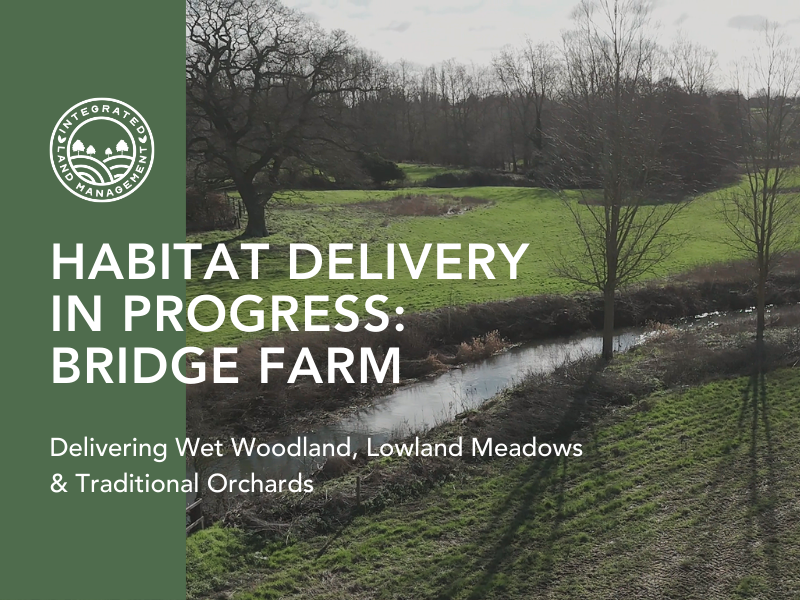
Follow the latest habitat creation work at Bridge Farm Biodiversity Gain Site, including wetland, grassland and habitat enhancement measures designed to generate Biodiversity Net Gain units for developers.
Two years after mandatory Biodiversity Net Gain was introduced, we review how the market has evolved, what developers and landowners have learned, and what changes may be coming next.
What’s been confirmed and why early groundwork is essential for NSIP planning and delivery.
Discover how Integrated Land Management helped David Lloyd Leisure secure Biodiversity Net Gain units, supporting planning compliance while providing certainty around off-site BNG delivery.
Explore the Bedmond Biodiversity Gain Site in Hertfordshire, where Biodiversity Net Gain units are available to support developers seeking off-site BNG solutions.
A practical guide to Biodiversity Net Gain trading rules, including habitat matching requirements, strategic significance, spatial risk multipliers and when off-site units can be used.
From padel courts and leisure centres to sports clubs and stadium developments, discover how Biodiversity Net Gain applies to sports facilities and how developers can achieve compliance.
Off-site Biodiversity Net Gain can provide greater flexibility, habitat choice and delivery certainty. Learn when purchasing BNG units may be more effective than on-site delivery.
Common Biodiversity Net Gain mistakes can delay planning and increase costs. Learn where projects go wrong and how early engagement can help achieve smoother BNG delivery.
Midloe Grange Habitat Bank offers Biodiversity Net Gain units in Cambridgeshire, helping developers meet BNG requirements while supporting long-term habitat creation.
Key Biodiversity Net Gain insights from UKREiiF 2025, including market trends, developer priorities, policy discussions and the growing maturity of the BNG sector.
Prospect Hill Habitat Bank provides Biodiversity Net Gain units in Northumberland, offering developers access to off-site BNG solutions in the North East.
Learn how landowners can sell Biodiversity Net Gain units through ILM, including habitat bank registration, brokerage support and listing opportunities on platforms such as Gaia.